
-
Seyed Ali Mosallaie, MD
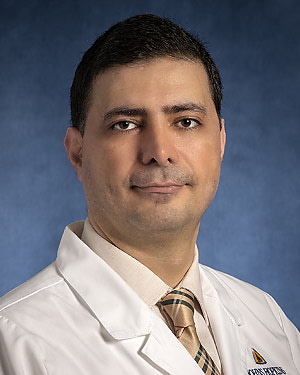
- Director, Nuclear Medicine Residency Program & PET/CT Fellowship Program
- Assistant Professor of Radiology and Radiological Science
-
Meisam Hoseinyazdi, MD

- Assistant Director, Division of Nuclear Medicine and Molecular Imaging
- Assistant Professor of Radiology and Radiological Science
Nuclear medicine is a specialized service division within the Russell H. Morgan Department of Radiology and Radiological Science that utilizes radioactive material to assess the function of organs or systems within the body. The mission of the Division of Nuclear Medicine and Molecular Imaging (DNMMI) is to lead in discovery, teaching and application of methods in precision health for justly distributed and improved patient-centric care.
Nuclear medicine plays a vital role in the diagnosis and treatment of a wide range of diseases, including cancer, cardiovascular conditions and infections. Unlike conventional imaging, it focuses on evaluating organ function and revealing molecular processes that reflect both normal physiology and disease. Imaging techniques such as Positron Emission Tomography (PET) and Single-Photon Emission Computed Tomography (SPECT) use small amounts of radioactive materials, known as radiotracers, which are administered to the patient to visualize biological activity within the body.
These radiotracers map organ function and can be used to create functional or molecular images. This provides more than just a picture of the organ; it produces images that contain organ’s functional data that can be analyzed and interpreted. In other words, these are quantitative (measurable) images. These unique images provide information that often cannot be obtained using anatomic imaging modalities, such as CT or MRI, and they offer the ability to identify diseases such as malignancy, infection, or inflammation at an early stage.
Patient Care
Our team conducts a wide variety of procedures each year combining individualized care, specialty expertise and advanced technology.
For our diagnostic services, we offer state-of-the-art, precision imaging technology combined with expert interpretation to provide unparalleled patient care.
About Clinical Molecular Imaging
Recent technological advances have led to the development of hybrid imaging systems that combine SPECT or PET scanners with computed tomography (CT) in a single camera system. These integrated systems provide comprehensive information during one noninvasive imaging study by combining molecular data from nuclear imaging with detailed anatomical information from CT.
When used with approved radiopharmaceuticals, these technologies enable the clinical application of quantitative molecular imaging, allowing physicians to visualize and measure biological processes within the body.
Molecular Imaging in Neurologic Disorders
Quantitative molecular brain imaging provides highly detailed information that supports the evaluation of suspected or known neurologic diseases. By assessing brain function and molecular activity, these techniques help clinicians better understand and diagnose conditions affecting the brain.
Molecular imaging plays an important role in the evaluation of disorders such as dementia, epilepsy, brain tumors, and Parkinsonian syndromes, supporting more accurate diagnosis and improved patient management.
These radiotracers map organ function and can be used to create functional or molecular images. This provides more than just a picture of the organ; it produces images that contain organ’s functional data that can be analyzed and interpreted. In other words, these are quantitative (measurable) images. These unique images provide information that often cannot be obtained using anatomic imaging modalities , such as CT or MRI, and they offer the ability to identify diseases such as malignancy, infection, inflammation,… at an early stage.
Nuclear Cardiology Imaging
To continue its longstanding history of leadership in biomedical imaging, the Johns Hopkins Division of Nuclear Medicine has recently enhanced and expanded its services with the most advanced nuclear imaging systems and additional expert clinicians. The novel SPECT/CT and PET/CT scanners now incorporate the most modern PET and SPECT detection methods with state-of-the-art multi-slice X-ray CT to increase diagnostic accuracy.
We offer cardiac imaging at the highest possible standard for the workup of suspected or known cardiovascular disease. Our program is continuously updated through incoming developments from our cardiovascular research program.
An unparalleled spectrum of nuclear imaging methods information can be provided even in the most challenging cases, to guide further clinical decision making based on reliable diagnostic and prognostic information. Virtually no patient is too small or too large for our services.
-
- Myocardial Perfusion SPECT (including assessment of ventricular function) with routine CT attenuation correction
- Myocardial Perfusion PET (including assessment of ventricular function) with CT attenuation correction
- CT-Determination of Coronary Calcium Score (in combination with either SPECT)
- Myocardial Viability Assessment by FDG PET
- Myocardial Metabolic Assessment by FDG PET
- FDG PET can also evaluate metabolic activity in the heart to detect inflammation. This is useful for diagnosing conditions such as cardiac sarcoidosis and for assessing infections of prosthetic heart valves or aortic grafts.
- Radionuclide Angiography (MUGA) for reproducible quantification of left and right ventricular function
-
Within recent years, a large body of evidence has accumulated to indicate that functional impairments are more closely related to development and outcome of heart disease than morphologic changes. Functional imaging techniques are thus often considered the superior methods to detect individuals at risk for cardiac events, to guide selection of appropriate therapy and to monitor the success of this therapy.
Nuclear imaging is a noninvasive functional diagnostic approach, which as single photon imaging, has been established for decades as a clinical cardiac tool. The distribution of bio-molecules, labeled with small doses of short-lived radioactive isotopes, is measured, allowing for assessment of myocardial perfusion, and contractile function. Single photon emission computed tomography (SPECT) is the standard technique, which provides high diagnostic accuracy, reliability and reproducibility. PET and the novel hybrid systems now available at Johns Hopkins are expected to increase accuracy even further, especially in large patients.
The most frequent, evidence-based clinical indications for nuclear cardiology testing are:
- Detection/exclusion of coronary artery disease
- Assessment of risk for cardiovascular events
- Determination of functional relevance of known coronary artery disease
- Monitoring of therapy for coronary artery disease
- Myocardial viability assessment in heart failure/after myocardial infarction
- Evaluation of global left ventricular function before and after chemotherapy
- Evaluation of the synchrony of left ventricular emptying with phase analysis
- Evaluation of right to left shunting
- Evaluation of myocardial sarcoidosis
- Evaluation of prosthetic cardiac valve, device, or graft infection








Research
Aligning with the mission of Johns Hopkins Medicine to improve the health of the community and the world by setting standards of excellence in clinical care, research and education, the DNMMI conducts research and develops educational programs and procedures to supply patients with the best and most innovative care.
The DNMMI research labs, advances nuclear medicine and molecular imaging through pioneering discoveries and translational research performed by our research faculty and physician-scientists. Our experts continually discover new imaging agents as well as repurpose existing agents in novel and exciting ways. For example, the DNMMI is working closely with the Departments of Urology, Genitourinary Oncology, and Radiation Oncology to discover therapeutic agents for prostate cancer, with DNMMI agents already being issued worldwide to help patients manage this disease.
DNMMI currently works with partners such as the National Institutes of Health, key industrial partners, and academic collaborators worldwide to create programs to develop agents beyond the standard agents for PET and SPECT. Those collaborations assist in fostering the development of new medical imaging techniques, disease treatments and interventional procedures from basic discovery to clinical trials including therapeutic trials. The division produces hundreds of publications yearly and garners millions in research funding as well as strong commercial ties and an extensive patent portfolio.
Education
With the goal of training the next generation of leaders in molecular imaging, Johns Hopkins has created a combined residency training program in radiology and nuclear medicine.
Residents gain outstanding clinical training and participate in cutting-edge research programs that prioritize moving molecular imaging from laboratory-based studies to clinical translation of new imaging and theranostic agents and techniques. Learn more about the program.