
A Lifeline in Huntington’s Disease
Patients and their families with this neurodegenerative condition — cruel in its genetic certainty — find support, community and hope at the Johns Hopkins HD center, where clinician-scientists are driven by the belief that HD is ‘uniquely solvable.’
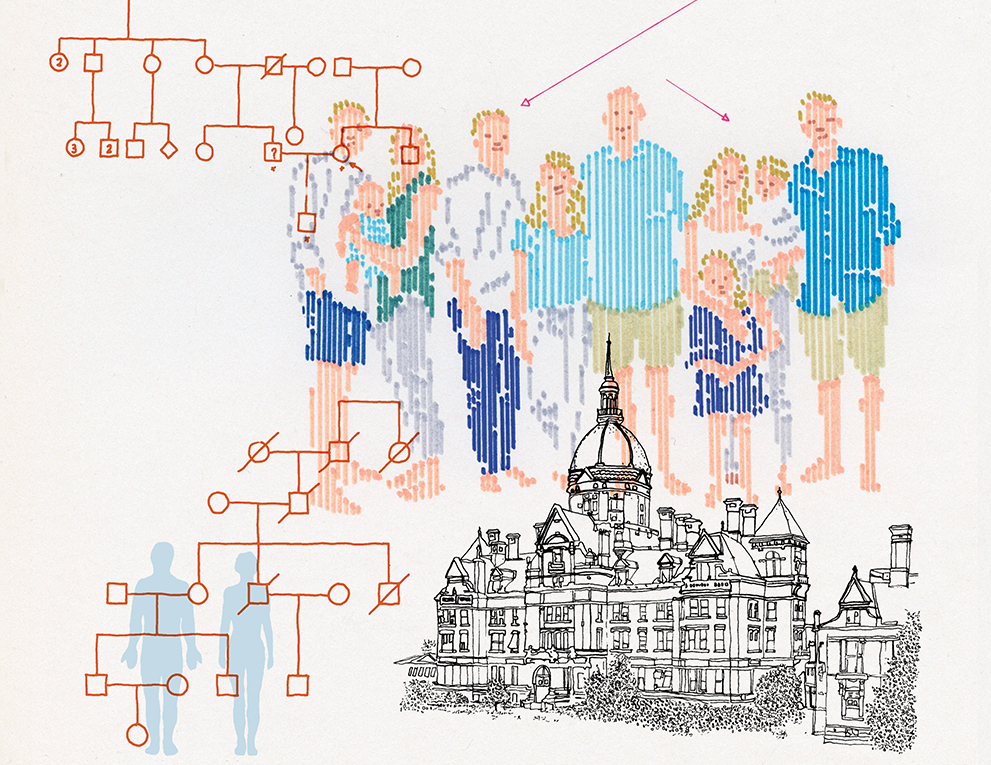
Illustration by Roderick Mills
On her 64th birthday in June, Sandy Vogel sat across from her husband at an Italian restaurant, staring at a flaming cannoli.
She squinted at the sparkler shooting from the top and asked, “Is that an LED?”
“It’s fire, hon,” her husband Dave told her gently.
After more than a decade of slow decline with Huntington’s disease, Sandy’s mind doesn’t always connect the dots the way it used to. But in that moment, Dave recalls, “We laughed our asses off.” After years with HD, they’re both experts in “gallows humor,” he says. “You have to be.”
When Sandy goes out in public, people tend to whisper or stare. Many assume she’s drunk. “She moves slow, she wobbles,” Dave says. He’s used to explaining Huntington’s disease — at restaurants, on airplanes, in grocery stores.
Dave and Sandy, who met as software developers for the Air Force, built a life in Maryland, running a software company together. “She was my backstop,” Dave says.
Around 2008, something shifted. Sandy was struggling with decisions. They both probably knew deep down what was happening, Dave now says. Sandy’s mother had been diagnosed with Huntington’s in 1997, the first known case in the family. It turned out others in the family had it, too.
Sandy waited until 2011 to confirm it. “It changed everything overnight,” Dave says. They abandoned plans to retire in North Carolina, and sold their business.
Rather than wallow, Dave threw himself into understanding Huntington’s and became active in advocacy groups, eventually leading the Chesapeake-area affiliate chapter of the Huntington’s Disease Society of America. “Anything we could do to help, we did,” Dave says.
They also became fixtures at the Huntington’s Disease Center at Johns Hopkins, where both Sandy and her mother received care. Dave joined the center’s advisory board, and Sandy took part in research trials.
“I think the center is a true gift,” Dave says. Though staff have come and gone over the 30 years the Vogels have been visiting, “what hasn’t changed is the care and empathy, the true concern for the community, that everybody in that office has had,” he says.
Located on Johns Hopkins’ East Baltimore campus, the Huntington’s center is among the most respected and longest-running in the country. Each year, it draws about 150 patients and their families — many from the mid-Atlantic, some from further and abroad — for comprehensive care from a team including neurologists, psychiatrists, a genetic counselor, a clinical social worker, and physical, occupational and speech therapists.
People with HD and their families come to the center for a variety of reasons: to learn their genetic status, to check on new symptoms as they emerge, to tweak medications, to join clinical trials. For many, it’s to establish a long-term relationship at an Huntington’s Disease Society of America Center of Excellence, a distinction Johns Hopkins has held for more than 25 years. In 2021, the center also received designation as a Johns Hopkins Precision Medicine Center of Excellence.
“We get to witness development of a unique bond built on mutual trust and open communication,” says Johns Hopkins neurologist Jee Bang, the center’s clinical director. “This is a very special and meaningful partnership that forms not only with the individual living with HD, but with their entire family.”

“We’ve seen some patients for decades,” says Christopher Ross, professor of psychiatry and behavioral sciences at Johns Hopkins, who served as the center’s director for more than 25 years. “They might come in twice a year or every few years, but we know them, and they know us. I’ve cared for patients, their children, and even their grandchildren.”
Beyond clinical care, the center’s physician-scientists are shaping what’s next for HD, advancing research that aims to delay onset or slow progression of the disease that affects more than 41,000 Americans. They’re focused on developing more precise tools, like biomarkers that detect the disease early and novel therapeutics — such as gene editing —and new delivery systems to administer them.
“While the disease is challenging, it often reveals a profound inner strength in the people who live with it, and it’s a privilege to work with them.”
Jee Bang
Genetic Certainty
Huntington’s disease is an inherited brain disorder that typically begins in midlife and progresses over 10 to 30 years. Early signs are subtle: mood shifts, slowed thinking, clumsiness or unsteadiness. Eventually, the disease strips away the abilities most people take for granted, like speaking clearly, walking safely, making decisions or feeding oneself. There is no cure, and the condition is always fatal, often from complications like pneumonia or a fall.
In the 18th and 19th centuries, HD was often misunderstood or missed entirely. Its signature jerky movements — known as chorea, from the Greek word for dance — once got patients misdiagnosed with madness and institutionalized. The disease finally got its name and accurate description in 1872 from a young physician, George Huntington, in East Hampton, New York.
Though HD shares traits with other progressive neurodegenerative diseases like Alzheimer’s and Parkinson’s, what sets it apart is its genetic certainty.

In 1983, scientists mapped the Huntingtin gene (HTT) to chromosome 4 — the first time DNA markers were used to locate an inherited disorder, and a breakthrough that laid groundwork for the Human Genome Project. Ten years later, a multi-institutional team of researchers isolated the mutation causing HD, a CAG sequence that repeats more times than it should. A count of 40 or higher means HD is guaranteed to develop.
“Because the length of the repeat is inversely correlated with age of onset, we can roughly predict not only whether but also when people with the HD mutation will become affected,” notes Ross.
Johns Hopkins’ history with HD traces back to the 1970s, when psychiatrists Paul McHugh, Susan Folstein and Marshall Folstein were reshaping how the medical community understood HD, acknowledging its prominent cognitive and psychiatric dimensions. They established the Huntington’s Disease Center at The Johns Hopkins Hospital, positioning the institution as a national leader in HD care and research. In the early 1990s, that foundation earned Johns Hopkins a designation as one of two NIH Centers Without Walls for HD.
Christopher Ross became the center’s director in 1993, as Johns Hopkins emerged as a key site for clinical trials and predictive genetic testing. He founded the Division of Neurobiology, where his lab and others contributed early insights into the HTT gene, including the discovery that it actively produces its protein product throughout the body — even though HD primarily and initially targets deep brain structures like the basal ganglia.
The team also showed that brain atrophy begins long before symptoms appear, pushing the field to focus more on early intervention.
That remains central to the center’s clinical mission today under the leadership of Bang, a neurologist who specializes in HD. “A lot of people don’t come to the clinic until they really have to,” she says. “But it’s become increasingly apparent that it’s ideal to connect with the HD center even before symptoms become noticeable.”
A 50-50 Proposition
Bang calls HD a “tip of the iceberg” disease: “Once you diagnose one person,” she says, “it’s likely the whole family is impacted.”
Huntington’s is inherited in an autosomal dominant pattern, giving each child of an affected parent a 50-50 chance of inheriting the mutation. Diagnosis is made possible with a simple blood test, even years before any symptoms appear.
For Debbie Trotter, now a patient at the Huntington’s Disease Center at Johns Hopkins, there was always a gut instinct that she carried the gene. In her early 50s, she decided, “I didn’t want to live with that question.”
During the COVID-19 pandemic, she completed a mail-in genetic test through Johns Hopkins. Her instinct was right.
She and her husband, Jason Shadid, spent a few sleepless nights absorbing the news — then began making changes. They designed a one-story house with accessible features. They booked a trip to Peru. “We were already planning for retirement,” Jason says. “But this made it feel more urgent.”
Trotter, a former federal agent, now works part time from home. She remains largely asymptomatic, but after years of caring for her mother — diagnosed in her early 60s— she knows what may come. Her biggest concern isn’t herself. “When we got married, he didn’t sign up for this,” she says of her husband.

Clinical social worker Anjana Chacko often works with people at Johns Hopkins during this phase, when they feel healthy but know they carry a genetic time bomb. “I love that I get to know people and help them while they’re still fully functional and mobile and intellectually themselves so I can help them plan well for the future,” she says.

One weighty question patients often face during this time is whether and how to have children. The center’s genetic counselor, Weiyi Mu, helps couples explore options like adoption or IVF with preimplantation genetic testing, offering emotional support through the process.
There are other minefields, like insurance denials and disability applications. Chacko points to one patient who was discharged from the military due to his HD diagnosis.
As the disease progresses, other challenges emerge with loss of income and identity. “I’ve had architects, real estate people, attorneys, doctors — people who handle million-dollar deals — who are not able to do that anymore,” Chacko says. “It’s humbling.”
Hope for Tomorrow
The official motto of the Huntington’s Disease Society of America is “Help today, hope tomorrow,” a nod to the reality that, for now, treatments are limited to managing symptoms, rather than preventing or halting the disease itself. FDA-approved drugs like tetrabenazine, deutetrabenazine and valbenazine help ease the involuntary movements of chorea, while antidepressants and antipsychotics are often used to treat psychiatric symptoms.
At Johns Hopkins today, recent research advances offer reason for “hope for tomorrow.”
On the imaging side, Bang and Ross are collaborating with colleagues, including radiologist Yong Du, to develop a PET scan biomarker that would allow scientists to visualize mutant Huntingtin protein in the brain years before symptoms appear. Johns Hopkins is the only institution worldwide testing this marker, with collaboration and support from the Cure Huntington’s Disease Initiative Foundation.
If successful, the biomarker could play the same role for HD that amyloid imaging has played for Alzheimer’s, Bang says — referring to the ability to “see” abnormal proteins in living patients, which has helped researchers track the disease and test whether drugs are working.
Such work gives Bang “more concrete reason than ever” to see a cure for HD within her lifetime.
Johns Hopkins Neurobiology Division neuroscientist Wenzhen Duan agrees with that. She says HD stands out among other neurodegenerative diseases like Alzheimer’s as uniquely solvable. “The other diseases are more complex,” she says. “But for Huntington’s, we know exactly just one gene mutation causes disease. Targeting this is a way to find a cure.”
Duan is working on that precise goal in her Translational Neurobiology Laboratory by refining gene-editing techniques that zero in on the mutated gene. Using CRISPR-Cas13d, her team has shown success in selectively eliminating the toxic RNA and proteins linked to Huntington’s.
Duan is also exploring a separate, equally novel approach, stimulating the brain’s “glymphatic” system, a waste-disposal network that appears impaired in early HD. Boosting it could help flush out damaging proteins.
Other labs in the Division of Neurobiology also contribute to the effort. Mali Jiang and Wanli Smith are exploring a novel immune-related mechanism that may provide new opportunities for therapeutics, and Russell Margolis works on HDL2 — a disease he and Ross discovered — which has a closely related clinical appearance to HD and may provide new insights. Pan Li studies other related CAG repeat disorders, SCA2 and SCA12.
Johns Hopkins is also a leading hub for clinical trials, testing drugs that lower Huntingtin protein to slow disease progression and perhaps one day prevent symptoms altogether. Current studies, Bang says, deliver therapies directly into the brain or through spinal-fluid injections, with oral drugs on the horizon.
On the latter front, Ross and Jiang are using stem-cell technology to screen patient-derived neurons for small molecules that could block HD-related toxicity. “If we can find small molecules that are truly neuroprotective, there are rapid and straightforward paths to developing oral treatments to change the course of HD,” Ross says.
The Johns Hopkins center is also committed to training the next generation of Huntington’s specialists. Bang co-founded ENGAGE-HD, a program that brings neurology residents and fellows from around the world for an immersion course. Building on that success, she helped launch a formal Huntington’s disease fellowship through the international Huntington Study Group, offering top trainees across North America the chance to study at select institutions with intensive clinical and research exposure within HD.
A Fiercely Supportive Community
As researchers pursue the next breakthroughs, the Johns Hopkins center remains a lifeline for those already living with the daily realities of HD.
“I immediately felt like I was surrounded by a group of people who could help me understand the disease and how to navigate it,” says Laura Ford, who’s been visiting with her husband John, now 63, since his genetic testing in the late 1990s.
For Dave Vogel, his work as a board member at the center gives him a way to fight back against the disease that’s reshaped his life. He helps plan events and fundraisers, contributes donations, and whenever possible, he says, “I work earnestly to help raise awareness about HD and the center’s excellent work.”
In general, the HD community is known to be fiercely supportive. Bang, Chacko and others describe it as unusually close-knit, compassionate, and generous, bound by a sense of shared experience. “There’s this kind of deep, almost instantaneous connection when families meet one another,” Chacko says. “It’s like, ‘You get it.’”
Bang adds: “While the disease is challenging, it often reveals a profound inner strength in the people who live with it, and it’s a privilege to work with them.”
To live with HD is to carry a brutal kind of certainty: not just that this disease will progress, but a sense of its shape, its timing, and its eventual end. Most HD patients say their diagnosis forces a new perspective on life and how to live it.
“Knowing this was coming, we lived our lives like there was no tomorrow,” says Ford of John’s healthy years. “And that’s a good thing.”
After Deb Trotter’s diagnosis, her aunt sent her a silver bracelet engraved with a traditional Apache blessing: “May you walk gently through the world and know its beauty all the days of your life.”
With the Vogels, even as Sandy declined, she stayed active — traveling, sailing in the Caribbean, tearing through a book each week. For years, she lived up to her old nickname, “Handy Sandy,” fixing things around the house and cooking meals. But by summer 2025, Sandy was bound to home most of the time, needing help with dressing, bathing and eating. She could no longer read, use her phone or walk unassisted. Dave was her full-time caregiver, with visiting nurses as backup.
Still, when Dave told his story this summer, he was planning two trips to Sandy’s favorite places: to Emerald Isle, North Carolina, and Key West in the fall. He made arrangements for renting wheelchairs and keeping hospice on call.
Dave says the Sandy he’s always known is still there beneath the disease.
“She still has her smile. Her eyes. She still tells me to be careful when I leave. She still gets stubborn about what she wants,” he says. “I don’t see what everyone else sees. I see her.”
To learn more or support the Huntington’s Disease Precision Medicine Center of Excellence, contact [email protected] or 410-955-8519. To make a gift online: visit: secure.jhu.edu/form/psych.